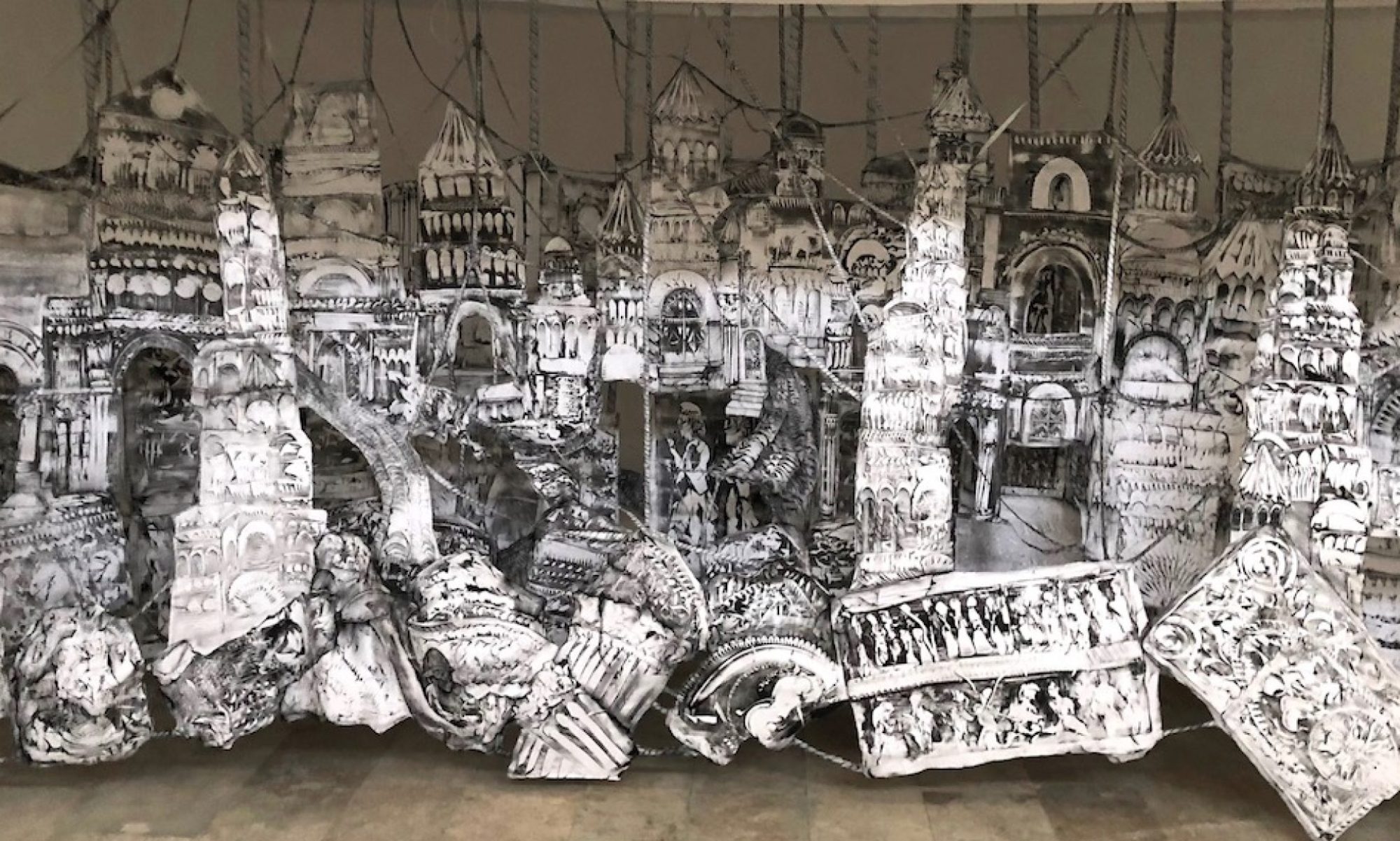
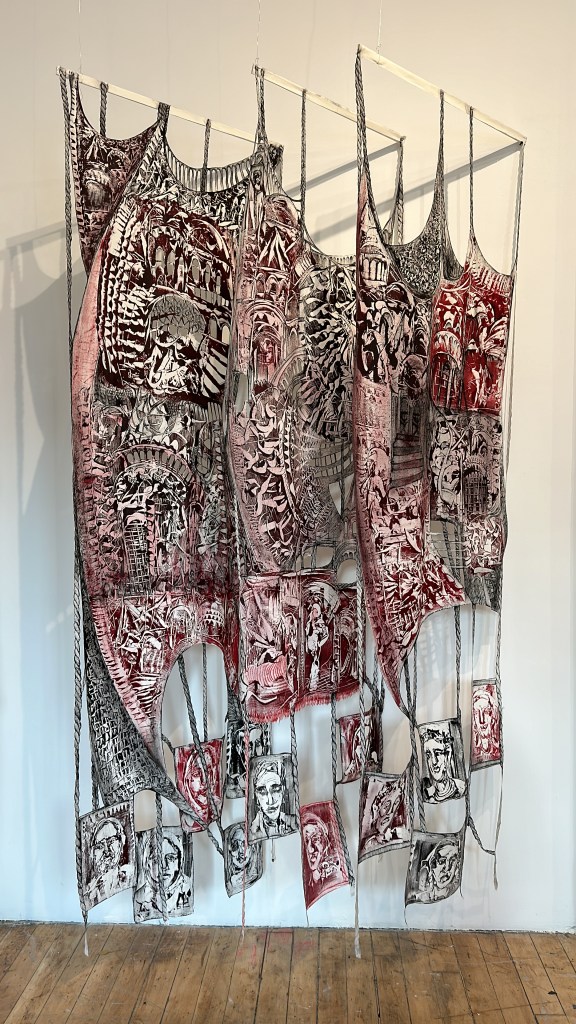
Sailing to Nowhere, 2024

This site-specific installation is 10 feet in height, with 8 feet width, 2 feet depth. Hung from the ceiling is a suspended boat, with sails made of printed structures inspired by Mesopotamian civilizations. These sails comprise 3 layers–forming archways and windows, upon which are printed ancient artifacts.
The bottom of the ship is open. Hanging from it are around 20 or 30 passport-like portraits of people, which move according to the air currents in the space. The people in the portraits are related directly to the ancient civilizations.
The entire structure is made of cotton fabric, with crimson and black acrylic paint.
Sailing to Nowhere was conceived in response to the refugee crisis, then and now.
It follows the plight and stories of refugees caught in the on-going war in the Middle East, the routes they travel to escape violence and the stories they carry with them. Today, we are witnessing the highest levels of displacement ever on record. Over 4.8 million refugees have fled Syria alone. 4,699 drowned in 2016 alone trying to cross the sea.
The art installation opened in January 2024 at the Sheen Center lobby and art gallery, 18 Bleecker Street, NYC. The Sheen Center has been reaching out to Arab artists to foster dialogue across culture and religion for years. The Sheen Center premiered this art exhibition, during the production of a play and a symposium on refugees.
Sailing to Nowhere was made possible by the New York State Council on the Arts with the support of the Office of the Governor and the New York State Legislature.
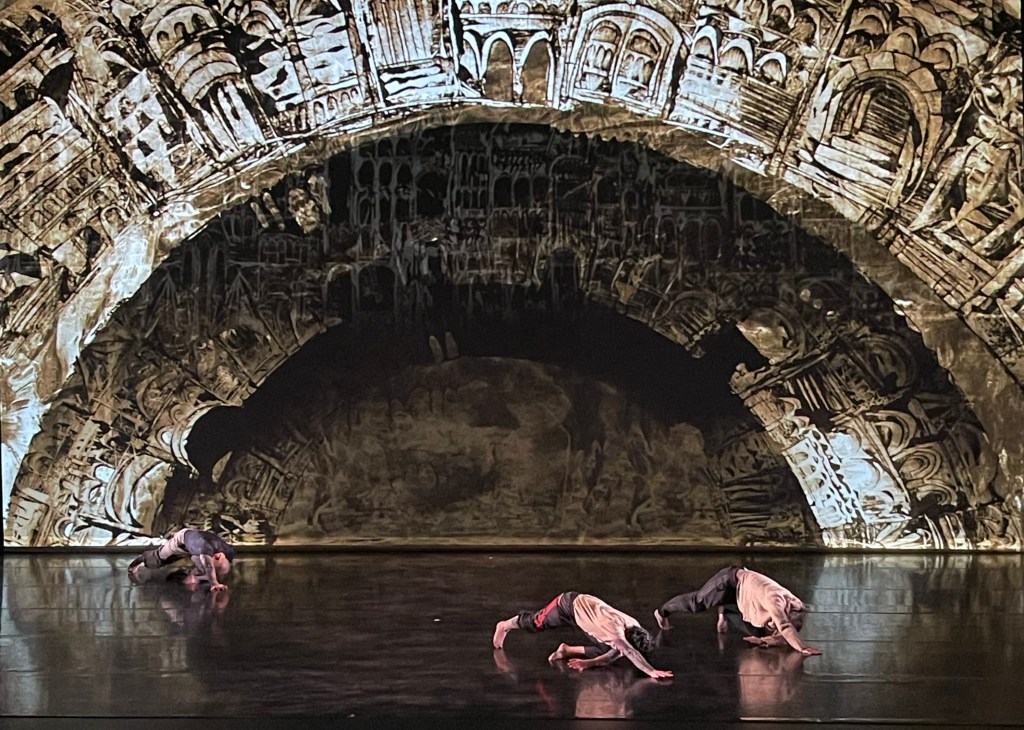
Invisible Cities, 2022

With Ashwini Ramaswamy. Dancer/Choreographer. Featuring 13 dancers, this reimagining of Italo Calvino’s metaphysical novel interweaves cultural perspectives with a dynamic group of lead artists—Ranee and Aparna Ramaswamy (Bharatanatyam), Berit Ahlgren (Gaga), Alanna Morris (Modern), Joseph Tran (Breaking)

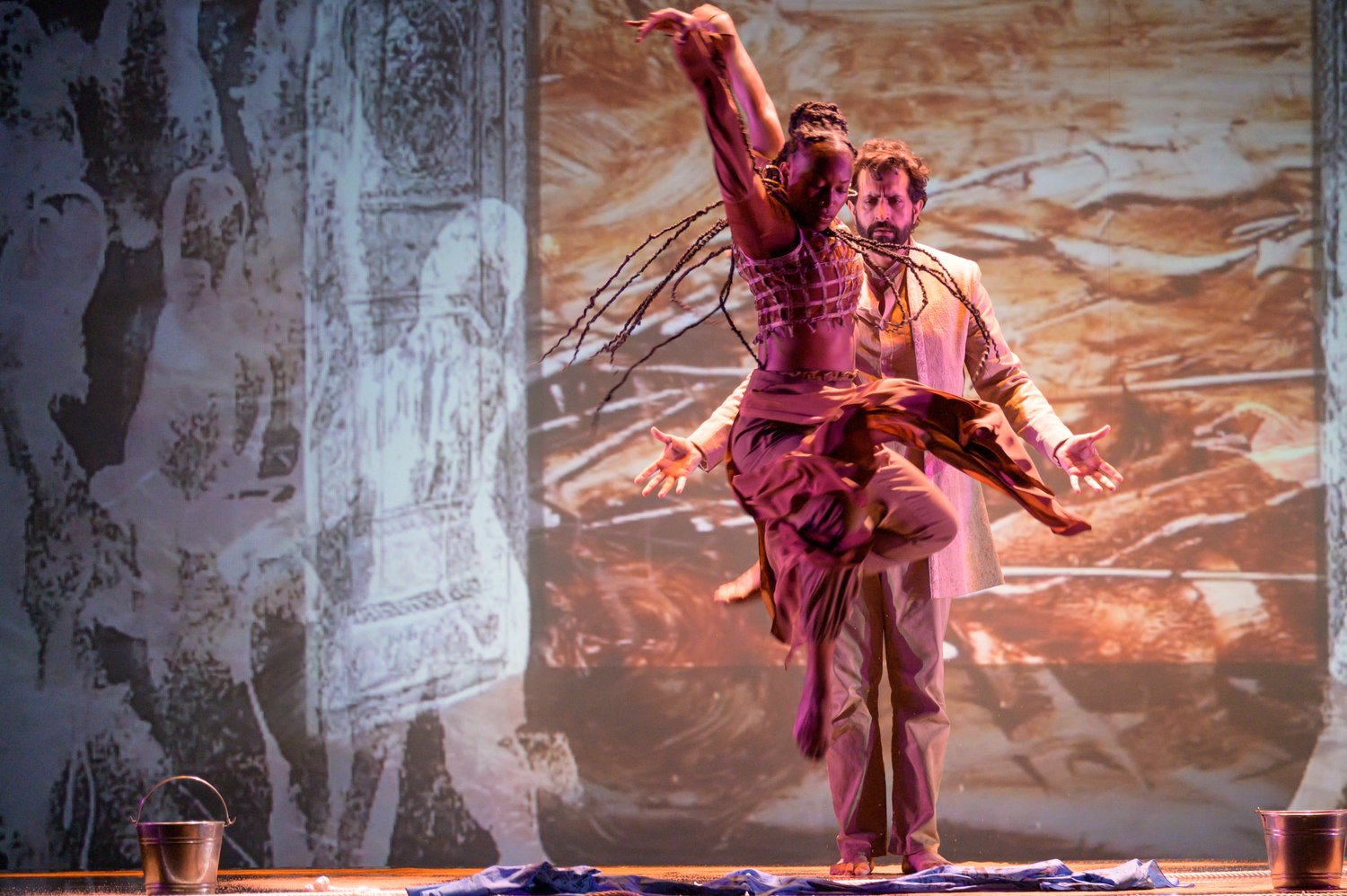
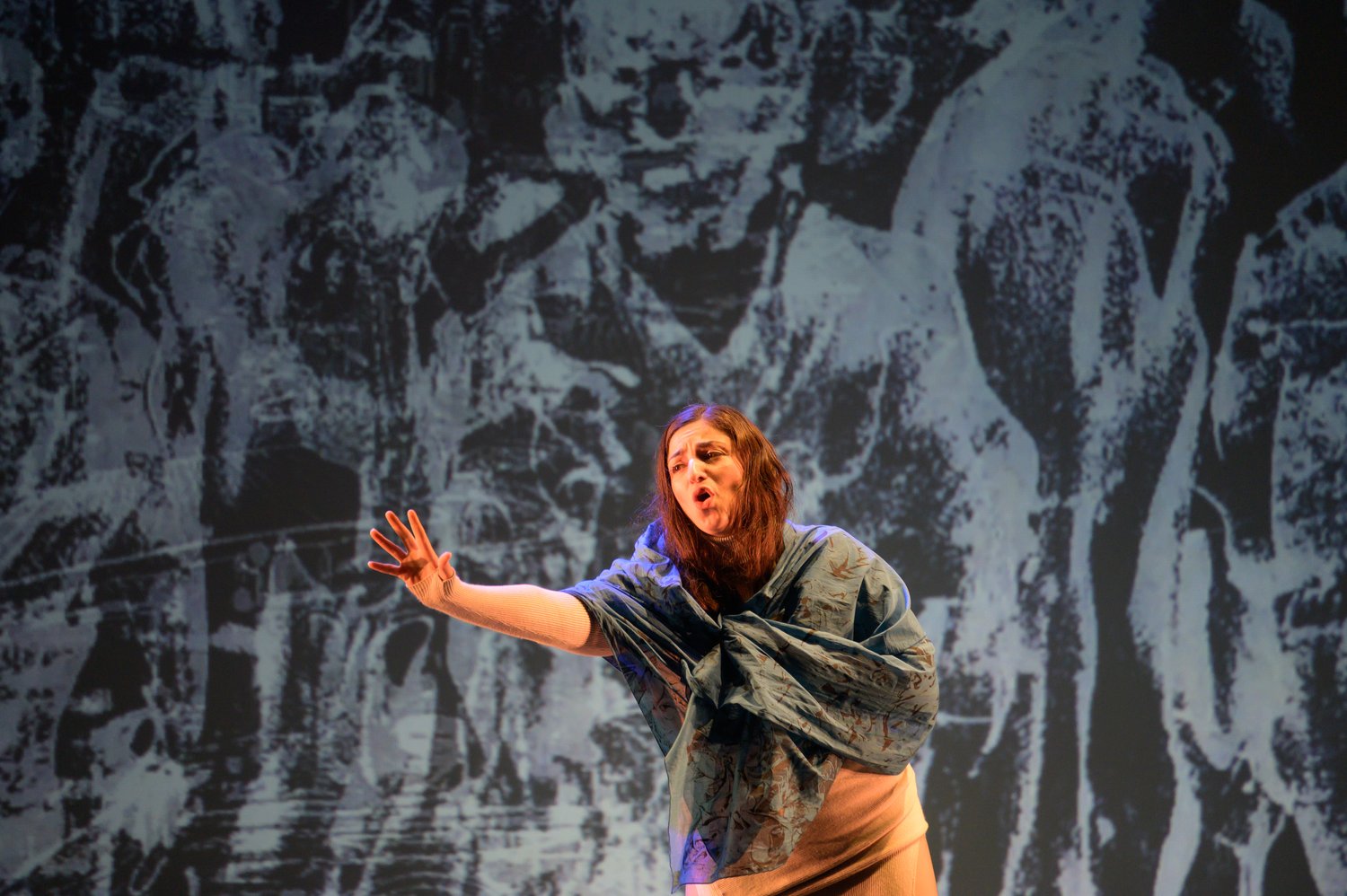
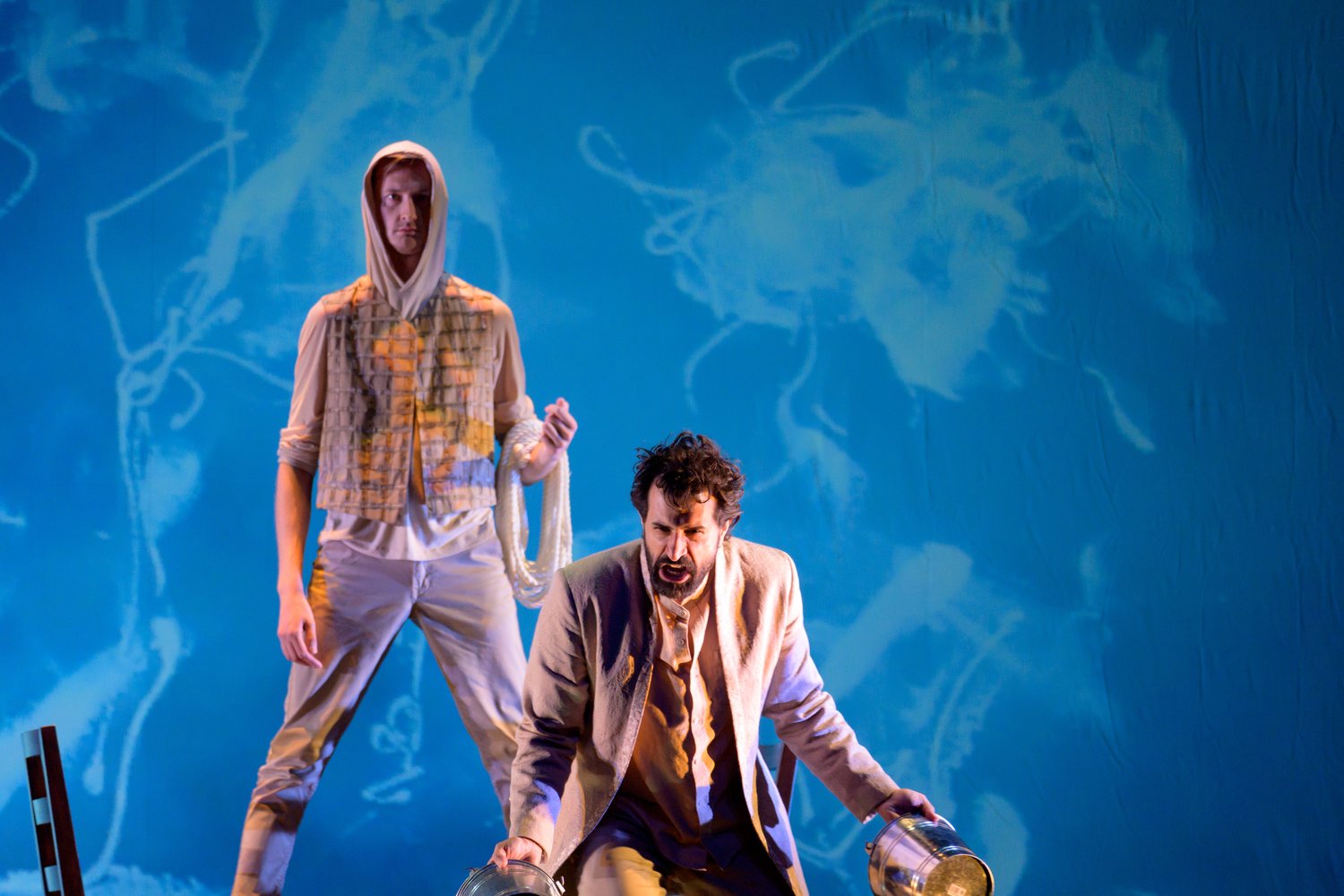
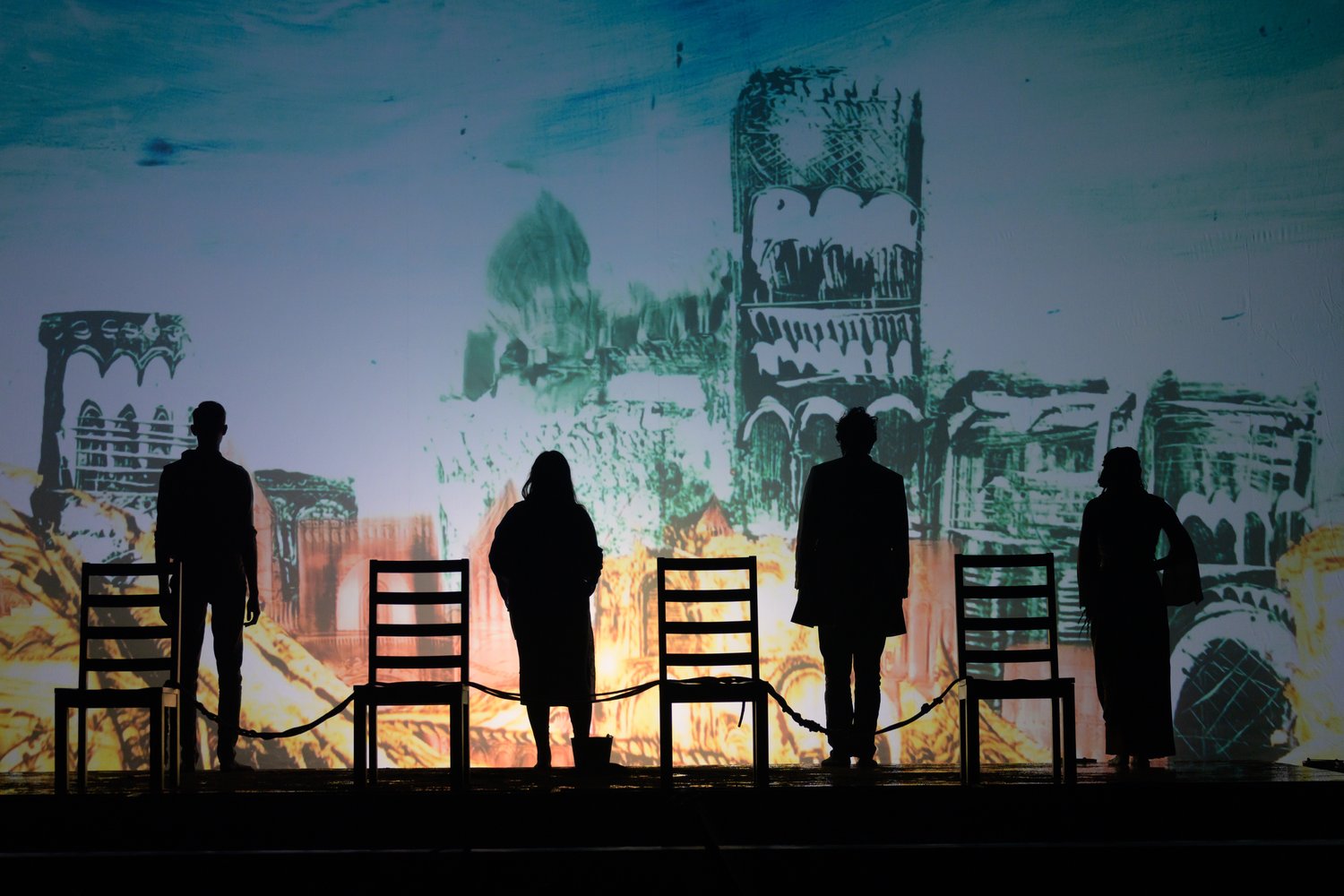
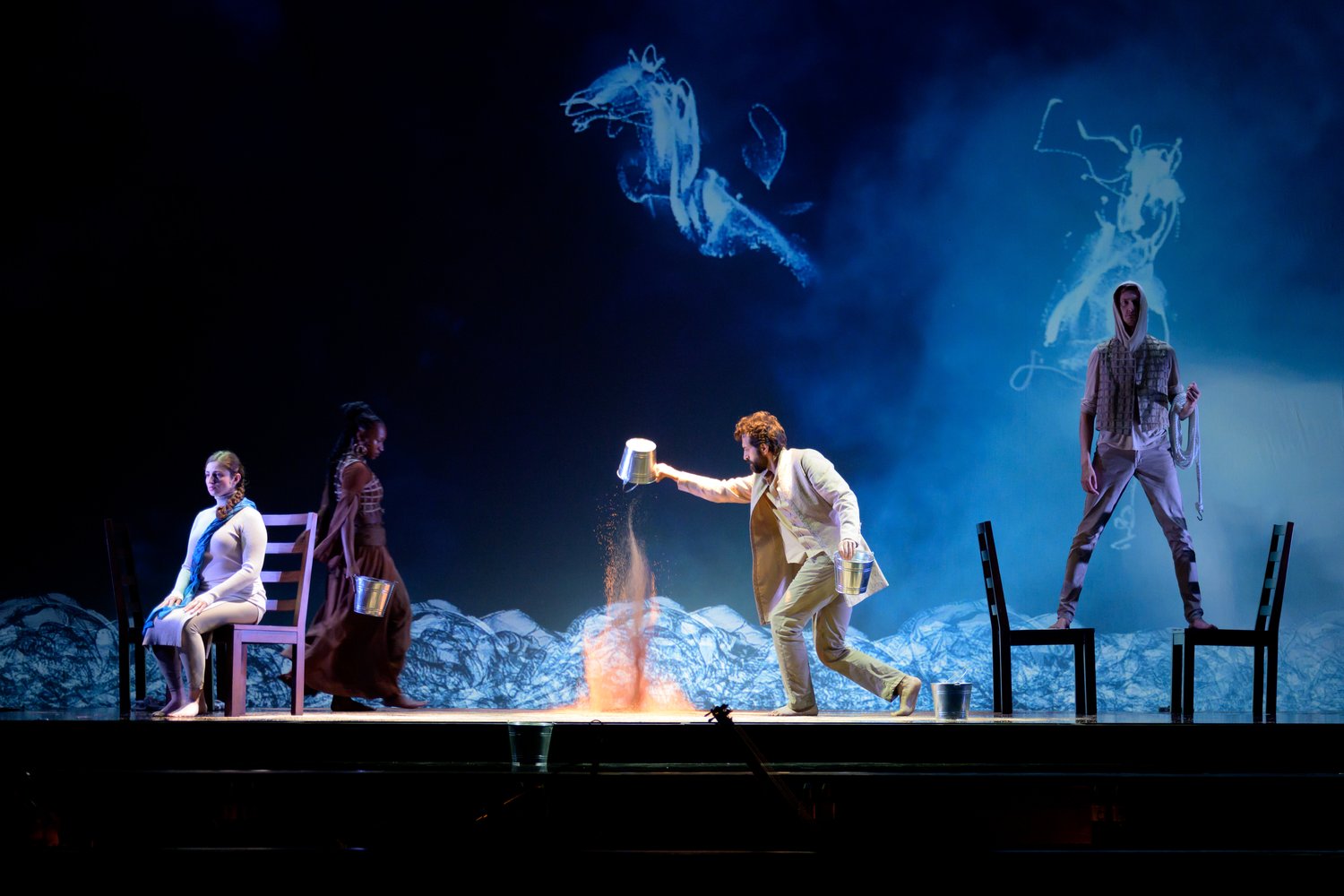
Unholy Wars

UNHOLY WARS
Conceived and performed by Karim Sulayman
Directed by Kevin Newbury
Music direction by Julie Andrijeski
Featuring Raha Mirzadegan, John Taylor Ward, and Coral Dolphin
Visual narrative, Kevork Mourad
Choreography, Ebony Williams
Associate Choreographer, Coral Dolphin
Original Music, Mary Kouyoumdjian
Lighting design, Jennifer Fok
Costume design, David Woolard
Projection design, Michael Commendatore
Projection Assistant, Javier Perez
Photography Leigh Webber

Four Acts For Syria, 2019

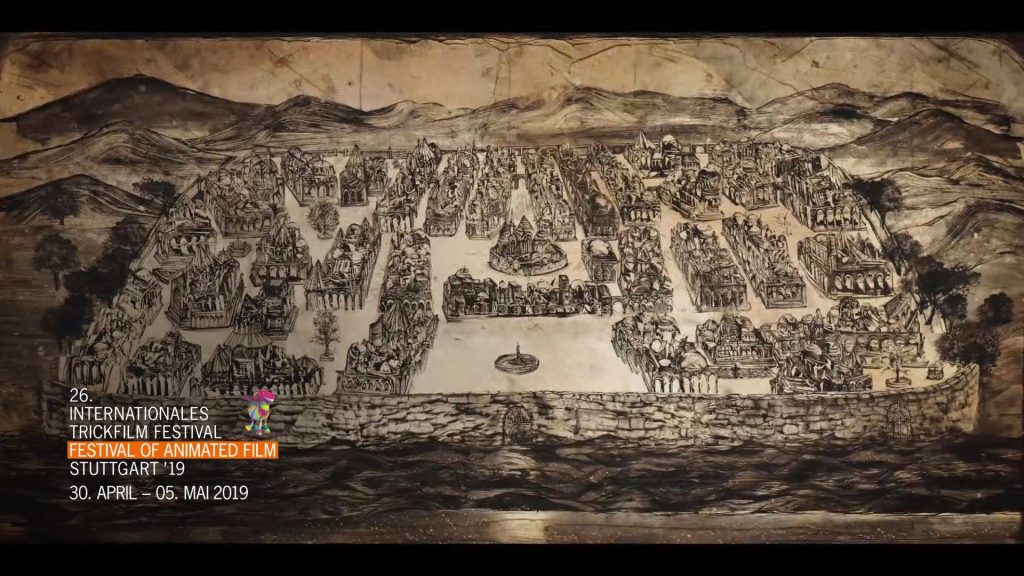
Animated short movie

This animated film was created with my film partner, Waref Abu Quba, who left Syria when the war started. Many of my ideas were inspired by my grandparents’ and parents’ stories, who told of living in a time in which Jews, Muslims and Christians lived together in Syria–in Qameshli, in Aleppo, and in Damascus. This film, created through the Robert Bosch Stiftung prize, is an homage to the country that was home to three generations of my family–refugees of the Armenian genocide–and to the culture that has most inspired my art and aesthetic. This visual journey, with a soundtrack by Kinan Azmeh and Zulal, the Armenian a cappella trio, and a poem written and recited by Raed Wahesh, explores the beauty and the recent tragedy that has defined this place, and opens outward with hope for a reconstruction that honors the historical and cultural wealth of my homeland.

Trailer

Well Wish Ya, 2019

The Herero and Namaqua genocide by the German Empire was the first genocide of the 20th century. This dance piece tells the story of that history through dance and visuals. I collaborated with the beautiful OYO Dance Company, choreographed by Philippe Talavera. The piece is about 70 minutes long and was premiered in April, 2019.

video

The Sound of Stone, 2018

This is a visual and musical piece that aims to re-create a world that no longer exists. Using images of artifacts, the piece recreates—through music and through live and animated visuals—worlds that we only know now from the fragments that time has allowed to survive. Composer Vache Sharafyan composed the music based on visuals by Kevork Mourad.

Performed by Zulal Armenian A Cappella Trio, Gevorg Dabaghyan, duduk, Shane Shanahan, percussion.

This piece was commissioned by the Metropolitan Museum of Art, and premiered at the museum on November 2, 2018.

Home Within, 2012

A 60-minute audio-visual performance, Home Within is a collaboration between Syrian composer and clarinetist, Kinan Azmeh, and myself. In this work, art and music develop in counterpoint to each other, creating an impressionistic reflection on the Syrian revolution and its aftermath. Rather than following a narrative, we document specific moments in Syria’s recent history and reach into their emotional content in a semi-abstract way. The cornerstone of the project was the single sound-image piece, “a sad morning, every morning,” released in March 2012. http://www.youtube.com/watch?v=nD9jbBFKetA

Home Within has been touring North America, Europe, and the Middle East, in efforts to raise awareness and funds for Syrian refugees through a number of charitable organizations.

The Island of Sighs (Akhtamar), 2018

The Island of Sighs is a multi-media theater piece incorporating live and pre-animated projected visuals (Kevork Mourad), dance (choreography and dance by Fadi Khoury), and live music (singer/writer Anaïs Tekerian), to tell the story of one of the most famous characters in Armenian lore. Tamar is a refugee of love and loss who is looking for her way off her island—a metaphor for the search of any victim of disaster to find his or her way forward out of the isolation of displacement and grief.

This piece was developed at BricLab, in Brooklyn, and performed as a work-in-progress in March 2018.

https://www.bricartsmedia.org/events-performances/island-sighs-work-progress

Lost Spring, 2015

Lost Spring was performed at the MuCEM in Marseille, the Morgenland Festival, and National Sawdust in New York. 

Lost Spring is a multi-media play, co-created by artist Kevork Mourad and singer/writer Anaïs Tekerian, with music by Anna Garano and featuring a dancer and a young actress.

How do you explain inhuman cruelty to innocence itself? How do you pass on a history like the Armenian Genocide to a bright-eyed child? What are your rights and duties in doing so?

Lost Spring asks these questions, through the incredible but true story of Mourad’s great-grandmother, who survived the Armenian genocide one hundred years ago.

Lost Spring is a moving, thought-provoking piece that delves into the ideas about the transmission of history, the duties of the parent and of the artist, the pain and the privilege of historical inheritance, and the poetic links between the image and the word, between movement and song…

Trailer